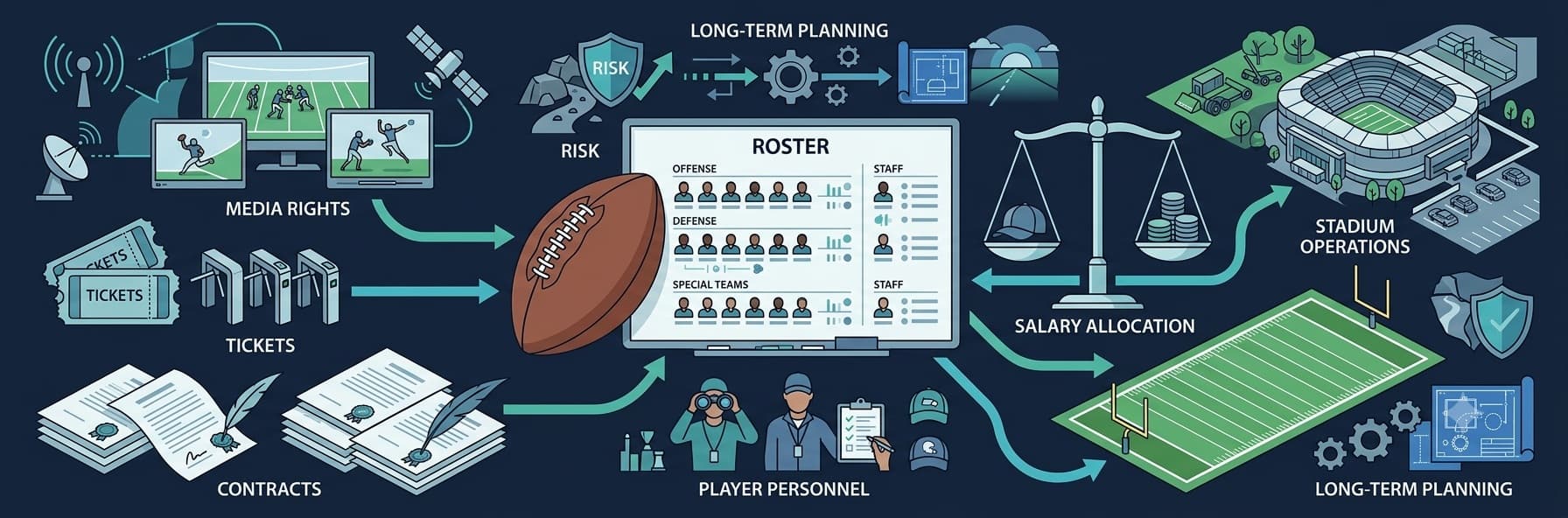
Professional football is both a sport and an economic system. The games fans watch are made possible by media agreements, labor contracts, shared revenue, stadium operations, and thousands of decisions about scarce money and talent. Those decisions offer a vivid way to learn financial ideas that apply far beyond football.
Football Is Also a Business
Fans see players, coaches, games, wins, and losses. Behind that visible competition is a network of team owners, league institutions, media companies, sponsors, stadium employees, medical and performance staffs, ticket buyers, merchandisers, and player representatives. Money enters the system through several channels, is divided under league and contractual rules, and is spent to stage games and build rosters.
This makes professional American football an unusually accessible case study in constrained budgets, labor compensation, revenue diversification, risk allocation, long-term contracts, asset values, and opportunity cost. A fan does not need an accounting or economics background to follow the system. The essential questions are familiar: What resources are available? Which commitments are fixed? What is uncertain? What must be given up when one option is chosen over another?
The discussion below focuses mainly on the economic structure associated with the NFL because terms such as salary cap, draft, and free agency depend on specific league rules. It avoids seasonal figures so that the underlying lessons remain useful as contracts, cap amounts, and media arrangements change.
1. Where Professional Football Revenue Comes From
A professional team can receive revenue connected to national media and streaming rights, tickets, premium seating and suites, sponsorships, advertising, licensed merchandise, local commercial partnerships, concessions, parking, and other stadium activity. League-level arrangements may also create or distribute revenue. These streams do not all have the same economics: some are negotiated nationally, some are generated locally, and some are divided according to league or contractual formulas.
This is revenue diversification. An organization supported by multiple revenue sources is generally less dependent on any single source. A sold-out stadium matters, but its physical capacity is limited. A national broadcast can reach millions more people. Sponsorship can monetize attention without requiring another seat. Premium spaces can generate more revenue per attendee than ordinary seats.
2. Why media rights matter so much
A stadium can sell only the seats it contains, but the same live event can be distributed to a national or international audience at the same time. Live premium programming is scarce, draws viewers at a scheduled moment, and can be valuable to advertisers, subscription services, and streaming platforms. Distribution expands the market without requiring the game itself to be replayed for each customer.
Three roles are worth separating. Teams and the league organize the competition and create the rights to show it. A media company distributes the broadcast. Advertisers or subscribers help fund that distribution. The exact arrangements vary, but the broad economic principle is durable: a product can become more valuable when distribution lets the same event reach millions of consumers simultaneously.
3. Revenue sharing and competitive balance
A football game requires two teams, and a league needs many financially viable clubs to create a season. Sharing certain revenue can reduce disparities in those streams, support teams in smaller markets, and help maintain a credible league-wide product. This is partly an effort toward competitive balance: keeping enough clubs capable of operating and competing to sustain fan interest.
Revenue sharing does not make every team financially identical. Clubs may differ in local sponsorships, premium seating, stadium arrangements, operating costs, debt, ownership decisions, market size, and brand strength. Nor does similar access to one revenue stream guarantee equal results on the field. Money, talent evaluation, coaching, health, and chance still interact.
4. Revenue is not profit
Revenue is money generated by the organization. Profit is what remains after expenses, under the relevant accounting rules. A team may generate enormous revenue while also paying for players, coaches, front-office staff, travel, facilities, medical and performance programs, technology, administration, marketing, stadium operations, and game-day labor.
Profit = revenue − expenses
Real franchise accounting is much more complicated than that equation, but the personal-finance lesson is direct: a large income does not automatically create a large surplus. The same distinction appears in a household’s income, expenses, and net worth. Cash coming in tells only half the story.
5. The Salary Cap: A Budget With Accounting Rules
A salary cap limits how much compensation can count against a club’s cap in a league year under rules negotiated through collective bargaining. It is not simply “the cash a team may spend this year.” A player can receive cash at one time while the cap system recognizes the corresponding charge across a different schedule. Existing contracts, bonuses, guarantees, incentives, and prior decisions all affect available room.
The cap creates scarcity. A club cannot keep every expensive veteran or buy every available skill. Even an owner willing to spend more must operate inside the negotiated system. Teams therefore prioritize positions, compare current needs with future flexibility, and search for productive labor at sustainable cap charges.
6. Opportunity cost and roster building
Opportunity cost is the value of the best alternative given up when a choice is made. If a club commits a large share of its cap resources to a quarterback, those resources cannot simultaneously fund some combination of offensive linemen, receivers, defensive backs, pass rushers, or depth. Spending heavily on an offensive line may make sense for one roster and not another.
There is no universally correct allocation. Teams have different coaches, talent, contract schedules, competitive timelines, and beliefs about replacement difficulty. To see the on-field job that can motivate investment in blockers, OpenPlay Football’s guide to pass protection (opens in a new tab) explains how an offense protects the passer. The economic lesson remains broader: every dollar committed to one purpose is unavailable for another.
7. How Player Contracts Work
A player contract may include base salaries assigned to particular seasons, a signing bonus, roster or workout bonuses, performance or participation incentives, guarantees, and option years. Not every contract contains every feature, and similar-looking terms may carry different conditions. Contract length also matters because it defines the period over which rights, obligations, and uncertainty may extend.
The largest number in a headline is often the maximum stated value, not the amount the player is certain to receive. Imagine a purely hypothetical five-year contract described as worth $100 million. Some compensation might be guaranteed, some might depend on the player remaining under contract in later years, and some might require performance or participation conditions. The headline is one fact, not a complete economic analysis.
8. Guaranteed money versus potential contract value
| Term | What it generally means | Question to ask |
|---|---|---|
| Total contract value | The stated or maximum value across the contract | How much depends on later years or conditions? |
| Guaranteed compensation | Money protected under specified contract terms | What kind of guarantee applies, and when? |
| Base salary | Salary assigned to a particular season | Is it guaranteed or conditional on remaining employed? |
| Signing bonus | Compensation for signing that may receive different cap treatment | When is cash paid, and when does the cap charge count? |
| Roster bonus | Compensation tied to being on the roster at a specified point | What event triggers payment? |
| Incentive | Compensation tied to defined conditions | Is the condition achieved, and how is it treated under cap rules? |
The broader financial-literacy principle is that the headline number is not always the economically meaningful number. When analyzing any contract, ask what is guaranteed, what is conditional, when cash is paid, which obligations continue, and what could change the outcome.
9. Cash spending and salary-cap accounting are different
A signing bonus illustrates the distinction. A team may transfer cash to a player near the beginning of a contract while negotiated accounting rules allocate the cap effect over multiple seasons. That means annual cash spending and annual cap charges can move differently. The cap is an accounting and competitive-balance mechanism, not a bank statement.
Businesses also distinguish when cash moves, when an expense is recognized, and when an obligation is created. The details are different, but the analytical habit is the same: do not treat cash flow, accounting expense, and contractual commitment as interchangeable.
10. Why teams restructure contracts
A restructure can change when cap charges are recognized, often creating room in the near term while increasing charges or reducing flexibility later. This can help a team address an immediate roster need, but it does not make the underlying economic commitment disappear. It changes timing.
The cautious personal-finance analogy is shifting an obligation into the future. Professional contract accounting is not the same as consumer borrowing, yet the core lesson transfers: moving a cost does not necessarily eliminate the cost. Short-term flexibility should be evaluated alongside future constraints.
11. Dead money and sunk costs
“Dead money” generally refers to cap charges connected to compensation already paid or committed even though a player is no longer on the roster. A sunk cost is a cost already incurred that cannot be recovered. The concepts overlap, but they are not perfect synonyms because cap charges are governed by specific rules and timing.
The decision principle is valuable: future choices should usually be evaluated using future costs and benefits, not by trying to justify money already spent. A team still must account for a prior commitment, but keeping an unsuitable player merely to defend the original decision may compound the mistake.
12. The Draft, Rookie Contracts, and Labor Allocation
The draft is a league-created system for allocating rights to negotiate with incoming players. Selection order, rookie compensation rules, contract length, and negotiating limits shape entry into this labor market. Teams are acquiring rights to employ people, not purchasing people, and the distinction matters. Players bring human capital—their developed knowledge, skill, health, and experience—into a demanding and risky career.
A high selection signals expectations, not certainty. Teams estimate how college performance, physical ability, learning, coaching fit, and health may translate to a different level of competition. The result is decision-making under uncertainty: a valuable draft right may produce an outstanding player, an ordinary contributor, or little on-field return.
13. Why productive young talent can be economically valuable
When early-career compensation is constrained by league rules, a productive young player may deliver unusually strong performance relative to the cap resources committed. That can leave room for veterans or depth elsewhere. It is one reason the quality of scouting and development can affect both football performance and financial flexibility.
Labor economics should not reduce players to spreadsheet entries. Athletes bargain, assume injury and career-length risk, develop scarce skills, and make choices about role and location. A club’s “value” calculation and a person’s compensation, security, health, and career goals are related but not identical.
14. Free agency as a regulated labor market
Free agency allows eligible players to negotiate under league rules, giving employers a chance to compete for scarce talent. Compensation matters, but so can contract length, guarantees, expected role, coaching, geography, family preferences, team competitiveness, and future opportunity. The highest nominal offer need not be the only meaningful offer.
Supply and demand influence compensation. If several clubs need a scarce skill and few suitable players are available, offers may rise. Yet compensation does not perfectly measure performance or social worth. Teams have imperfect information, different forecasts, and negotiated constraints. This is not a perfectly free market; it is a market operating inside institutions and rules.
15. Supply, demand, and scarcity
Elite players, roster places, salary-cap room, draft selections, playing time, and coaching talent are all scarce. When demand for a scarce skill exceeds its available supply, compensation or trade value can rise. When several credible alternatives exist, an employer may have more bargaining power. League rules place boundaries around both processes.
This is a useful correction to simplified descriptions of markets. Real markets rarely exist without rules. Contracts, eligibility, bargaining agreements, antitrust law, organizational policies, and social norms shape who can transact and on what terms.
16. Why different positions are paid differently
Position pay can reflect perceived impact, scarcity, replacement difficulty, demand, career length, the supply of qualified players, and strategic importance. It does not prove that one position “deserves” more, nor does it guarantee that the highest-paid player will create the most value. Compensation is the outcome of a particular labor market, contract negotiation, and moment in a team’s roster cycle.
Readers who want to understand the different jobs behind those labor-market values can use OpenPlay Football’s visual overview of football positions and responsibilities (opens in a new tab). Knowing what a tackle, tight end, safety, or edge defender actually does makes the economic tradeoffs less abstract.
17. Personnel groups: economics becomes football
A front office spends years acquiring, developing, retaining, and releasing players. On game day, coaches decide which combinations take the field. Offenses often describe personnel groups by the numbers of running backs and tight ends, with the remaining eligible skill players generally being wide receivers.
That brief definition is enough for the economic connection: roster construction determines which combinations are available. OpenPlay Football explains how football personnel groups work (opens in a new tab) and how coaches use them. Finance determines which resources reach the roster; strategy determines how those resources are combined.
18. The Economics of Depth
Football creates injuries, fatigue, situational substitutions, and specialized roles. A roster made only of stars would be unaffordable under a cap and incomplete on game day. Clubs balance elite talent, reliable starters, backups, developmental players, and special-teams contributors. Concentrating resources can create a dominant strength; preserving depth can reduce dependence on a few outcomes.
This resembles diversification only in a limited sense. A football roster is not an investment portfolio, but both problems ask how much to concentrate and how much resilience to preserve. The tradeoff also reaches formations: different combinations of rostered players allow different offensive formations (opens in a new tab) and answers to different situations.
19. Trades as voluntary exchange
Trades exchange scarce resources, which may include players, draft selections, and permitted financial or cap considerations. Both clubs can rationally agree because they value the pieces differently. One may need immediate help; another may prefer future flexibility. One may project a player as an ideal fit; another may expect a different role or development path.
Voluntary exchange does not require both sides to hold identical beliefs. It often occurs precisely because their needs, timelines, alternatives, and forecasts differ. The eventual winner of a trade can look obvious only after uncertainty has resolved.
20. Draft picks as future resources
A future draft selection has value before anyone knows the player it will produce. The exact draft position may be uncertain, the available prospects will change, and the selected player’s career remains unknowable. What the pick provides is an opportunity—a future right to choose from a pool of incoming talent.
That creates a choice between present and future resources. Trading a pick for a current player can reduce uncertainty and help now, but it surrenders future optionality. Acquiring picks can preserve more future paths, but it delays the benefit and leaves development risk. Neither choice is automatically superior.
21. Stadium Economics
Stadium activity can produce revenue from tickets, suites, premium seating, concessions, parking, sponsorship, naming arrangements, and non-football events. It also creates substantial costs: land, design, construction, financing, maintenance, staffing, security, utilities, operations, and periodic renovation. The party receiving a revenue stream may not be the same party paying every cost.
Financing can be private, public, or a combination. Economists and policymakers debate public subsidies, economic-development claims, displacement of other spending, and the distribution of costs and benefits. The relevant concept is opportunity cost: public or private capital committed to a stadium cannot fund another project at the same time. This framework does not assume that every subsidy is beneficial or harmful; it asks for transparent alternatives and evidence.
22. Franchise value is not the same as annual profit
A franchise’s estimated value is a view of the asset, not a measure of one year’s profit. A valuation may reflect expected future revenue, the scarcity of available teams, brand strength, media rights, market characteristics, league economics, and prices paid in comparable transactions. Different analysts can reasonably produce different estimates.
Asset value reflects expectations about future benefits, not merely current income. That parallels the distinction between a household’s annual income and net worth, although a sports franchise is far more complex. None of this implies that readers should invest in teams or related securities.
23. Why scarcity can make franchises extremely valuable
Major-league franchises are limited in number, while many wealthy buyers or groups may want the prestige, influence, and expected future benefits of ownership. Supply is constrained, transactions are infrequent, purchase prices are enormous, and league approval creates another barrier to entry. Scarcity can therefore support high values.
Scarcity is not a guarantee of perpetual price increases. Future media demand, borrowing costs, league policies, operating performance, and buyer preferences can change. A scarce asset can still be overvalued, and an estimated value is not the same as cash available today.
24. The league as both competitors and partners
Teams compete intensely for wins, players, attention, and local revenue. Economically, however, they also need one another. Without opponents there are no games; without a coordinated season there is no coherent media product. Clubs cooperate on scheduling, playing rules, league governance, shared commercial structures, and some media activity.
This combination of competition and cooperation is one of sports economics’ defining features. A club benefits from defeating an opponent on Sunday while also benefiting from that opponent remaining capable of returning next season.
25. Collective Bargaining Shapes the Market
The economic relationship includes owners, players, league institutions, and player representation. Through collective bargaining, the parties negotiate rules that can govern compensation systems, benefits, working conditions, free agency, cap mechanisms, and roster procedures. These rules are not simply produced by supply and demand; they are institutional choices resulting from bargaining power, priorities, and compromise.
Professional football therefore illustrates markets shaped by contracts and institutions. This article offers an educational overview, not a legal interpretation. The controlling agreement and individual contracts contain details and exceptions that a broad explainer cannot capture.
26. Risk is shared in different ways
Players face performance uncertainty, injury exposure, short or unpredictable career length, and contract conditions. Teams face the risk that performance will disappoint, injuries will reduce availability, commitments will limit future choices, or the roster will fail competitively. Media companies and sponsors assume commercial risks about audiences, advertising demand, subscriptions, and brand association.
Contracts often answer a central finance question: who bears which risk? Guarantees can move some employment risk from a player to a club. Incentives can move some payment risk in the other direction. Diversifying revenue can reduce dependence on one market. Readers can explore the broader logic of transferring and retaining risk in the insurance course.
27. Incentives matter
A contract may tie compensation to participation, performance, or defined achievements, depending on its terms and league rules. Incentives attempt to align compensation with outcomes that the parties value. They can also have unintended effects if a metric rewards narrow behavior at the expense of a wider goal.
Whenever compensation depends on a metric, ask two questions: What behavior does this measure reward, and what behavior might it unintentionally encourage? The question applies to employee bonuses, sales commissions, executive pay, school targets, and personal goals—not only football.
28. The time value of money
A dollar today and a dollar several years from now are not economically identical. Money available now can be saved, invested, or used; future payment carries time and uncertainty. Multi-year contract totals should therefore not be read as though every dollar arrives immediately. Payment timing and guarantee strength both matter.
This is the starting point for discounting future cash flows. Guided Personal Finance’s time value of money lesson develops the idea with personal-finance examples.
29. Competitive windows and intertemporal tradeoffs
A team may believe it has an unusually strong chance to compete during a particular period because of player age, contract timing, quarterback play, roster depth, or available resources. It may then favor current contributors and near-term cap room. Another club may preserve future draft choices and flexibility while developing.
These are intertemporal tradeoffs: choices between benefits today and benefits tomorrow. Pulling resources forward can strengthen the present and constrain the future. Saving resources for later can preserve options and miss a current opportunity. Sound analysis makes the tradeoff visible rather than pretending one timeline is free.
30. From the Business Office to the Football Field
Revenue → financial rules → roster decisions → personnel → formations → plays → results
Revenue and league rules affect who can be signed, retained, developed, or released. Those choices determine depth and the strengths and weaknesses available to coaches. Financial economics can explain why a club commits resources to pass rushers or why it accepts future cap constraints, but it cannot explain how a defensive coordinator uses the resulting front during a game.
That is where football strategy begins. For example, OpenPlay Football’s explanation of defensive fronts and alignments (opens in a new tab) shows what coaches can do with the defenders a front office has assembled. The two views are complementary: finance explains the constraint; football explains the use.
31. Learn the game behind the business
Understanding why teams pay for quarterbacks, offensive linemen, receivers, pass rushers, and defensive backs becomes easier when their jobs are visible. OpenPlay Football teaches positions, personnel groups, formations, running and passing concepts, pass protection, defensive structures, and the decisions that connect them.
Companion resource
See how the roster becomes a game plan
Continue from team economics into the personnel, formations, and strategy used on the field.
The Financial System Behind a Team
| Financial concept | Football example | General lesson |
|---|---|---|
| Revenue diversification | Media, tickets, sponsorships | Multiple revenue sources reduce dependence on one channel. |
| Scarcity | Limited elite players and franchises | Scarce resources can command greater value. |
| Opportunity cost | Paying one player limits other spending | Every allocation prevents another allocation. |
| Budget constraint | Salary cap | Resources are finite, and prior commitments matter. |
| Risk | Long-term player contract | Future performance and availability are uncertain. |
| Incentives | Performance-based compensation | Metrics can influence behavior and create side effects. |
| Sunk cost | Prior contract commitments | Past costs should not dictate every future decision. |
| Time value | Multi-year compensation | Timing affects economic value. |
| Resilience | Reliable backups and depth | Concentration can create vulnerability. |
| Asset value | Franchise valuation | Value reflects expected future benefits, not only current income. |
Check Your Understanding
Why is team revenue different from team profit?
Revenue measures money generated; profit accounts for expenses and the applicable accounting treatment.
What opportunity cost can arise from paying one position more?
The same cap resources cannot also fund another position, greater depth, or future flexibility.
Why can a large contract headline be misleading?
The total may include conditional incentives, non-guaranteed seasons, and payments spread across years.
Why might a team exchange a current player for future draft selections?
The teams may have different timelines, needs, forecasts, and preferences for flexibility versus certainty.
Why does revenue sharing not make every franchise identical?
Local revenue, costs, stadium arrangements, debt, market strength, and ownership decisions still differ.
How can shifting cap costs create flexibility and risk?
It opens room now but can add future charges and reduce later options.
Why might scarcity affect one position’s salary more than another’s?
High demand combined with few qualified alternatives can increase bargaining value.
Why is franchise value different from annual income?
Value reflects expected future benefits and scarcity, while annual income covers only one period.
Key Takeaways
- Revenue and profit are different: impressive sales do not reveal the surplus after costs.
- Diversified revenue sources matter, and the path of each dollar depends on contracts and league rules.
- Salary caps create scarcity, recognize commitments across time, and force prioritization.
- Contracts allocate payment timing, guarantees, incentives, obligations, and risk.
- Opportunity cost appears in every roster decision because one use of resources prevents another.
- Current players and future draft resources involve tradeoffs among certainty, timing, and optionality.
- Teams are unusual competitors because they must also cooperate to create a league product.
- Collective bargaining and institutional rules shape the football labor market.
- Franchise value reflects expected future benefits and scarcity, not merely this year’s profit.
- Financial decisions ultimately determine which players and combinations coaches have available.
Primary References and Further Reading
This guide emphasizes stable concepts rather than one season’s figures. The following official resources document the NFL-specific rules summarized above and should be consulted for current details:
- NFL Football Operations: salary cap (opens in a new tab)
- NFL Football Operations: contract language (opens in a new tab)
- NFL Football Operations: free agency (opens in a new tab)
- NFL Football Operations: collective bargaining agreement overview (opens in a new tab)
Educational content only. This page does not provide personalized financial, investment, tax, or legal advice.